About half a year ago, I walked into a gift shop looking for a bat mitzvah present for my niece. I could have ordered something online, but I went in on purpose. I had no idea what twelve-year-olds were into, and I wanted the kind of guidance you only get from a local boutique.
The saleslady was busy wrapping another customer’s gift, twirling ribbons, taking her time. I wandered the aisles picking up necklaces and journals, waiting for her. When she finally came over, she gave me the full tour, steered me to an adorable custom jewelry box, and I walked out grateful.
A few months later I went back. This time I knew exactly what I wanted: a gratitude journal, in a specific color, from a shelf I could have found with my eyes closed. And I’d given myself ten minutes.
The saleslady was free this time, and she came straight over. You’re back! Did your niece love the jewelry box? Wait, you have to see these. She marched me to a wall of Squishmallows. The axolotl was flying off the shelves. One glowed in the dark. The strawberry cow was scented, and she handed it to me to smell.
The cow did smell good, which is not something you can say about every cow. And she remembered me and my niece six months later, which is impressive. But I wasn’t shopping for a twelve-year-old anymore. She was in my way.
So is she helpful or annoying? It depends. She isn’t inherently either. It depends entirely on what I need in that moment, and what she’s offering me in that moment.
That’s the opening of my Women in Experimentation Summit talk, which dropped as a special episode of Churn Flags. This post walks through the whole talk: the argument, the framework, and all nine stories, in the order I told them.
Whatever your team answers, it’s probably “new”
Picture an all-hands. You ask your team: what’s the last initiative we ran to grow revenue from existing customers?
Maybe you shipped an MCP and usage is up. Maybe your AEs ran a land-and-expand sprint and seats are growing. Maybe you acquired a product and you’re folding it into the suite. Whatever comes to mind, I’d guess it’s some version of new – a new feature, a new segment, a new tier. That’s how we define expansion as an industry: if we want to sell them something more, we have to build them something new.
Especially now. AI is shipping everything faster, and every one of us is shipping more than we ever have.
If new were the answer, NRR would be ticking up. It isn’t.
The best way to get existing customers to spend more usually isn’t to build them something new. It’s to show them what you’ve already built, at the moment they’re open to hearing about it. Our products aren’t the problem. We’ve always been good at shipping.
Your customers have blinders on (and so do we)
Your existing customers are in your product every day. They see it through the lens of habit, so they think they know it cold. They built their habits around the features they onboarded on, and they’ve subconsciously concluded that the product you were when they signed up is the product you are today.
And we have our own blinders. As an industry we put more weight on demand gen and acquisition than on retention, even after hearing the HBR stat about acquisition costing five times more than retention a million and a half times. There’s a subtle mindset that once a customer adopts, we have them. Of course we tell them about the new stuff, and of course we want them happy. But they’re sold. They’re in the product. They know what they have access to, because they have access to it.
Put those two together and you get something strange: the outside market has a better picture of what your company does than your own customers do. Your prospects have seen this year’s website. Your customers are working off the mental version of the one they saw when they signed up.
Which means we almost have to shout louder at customers than at leads. A lead is open – no preconceptions, no habits, nothing to undo. A customer already holds a picture of you, and you have to actively change their mind. More emails, more tooltips, more pop-ups.
“More pop-ups? We’re trying to cut back.”
I know. We want to say less, not more. Pop-ups get in people’s way, so we use them sparingly.
So go back to the saleslady. When was she in the way? When I already knew what I wanted. Our users have built habits too, and often they log in with a goal and don’t want anything between them and it. But sometimes things change and they do need help – and when I walked in needing help, she was the opposite of annoying. I was looking for her.
Pop-ups aren’t inherently annoying or inherently helpful either. The problem was never how much we communicate. It’s whether what we have to say is relevant when they see it.
We already understand this intuitively. Look at the lifecycle. We front-load communication: during onboarding we’re happy to send emails and nudges, because we know they need the education. We do the same at the other end – when the retention dashboard fires, we’re fine sending win-backs and nudges again.
But in all the space between adoption and about-to-leave, we don’t feel allowed to send anything except launches. New, new, new. Meanwhile, there are moments in that middle stretch when customers need help, they’re floundering, and we don’t notice.
The Change Flags™ framework: nine moments, three sides
Those moments are what I call Change Flags: nine moments in the customer lifecycle when something shifts and reevaluation begins, well before anything fires on the at-risk dashboard. They sit on three sides:
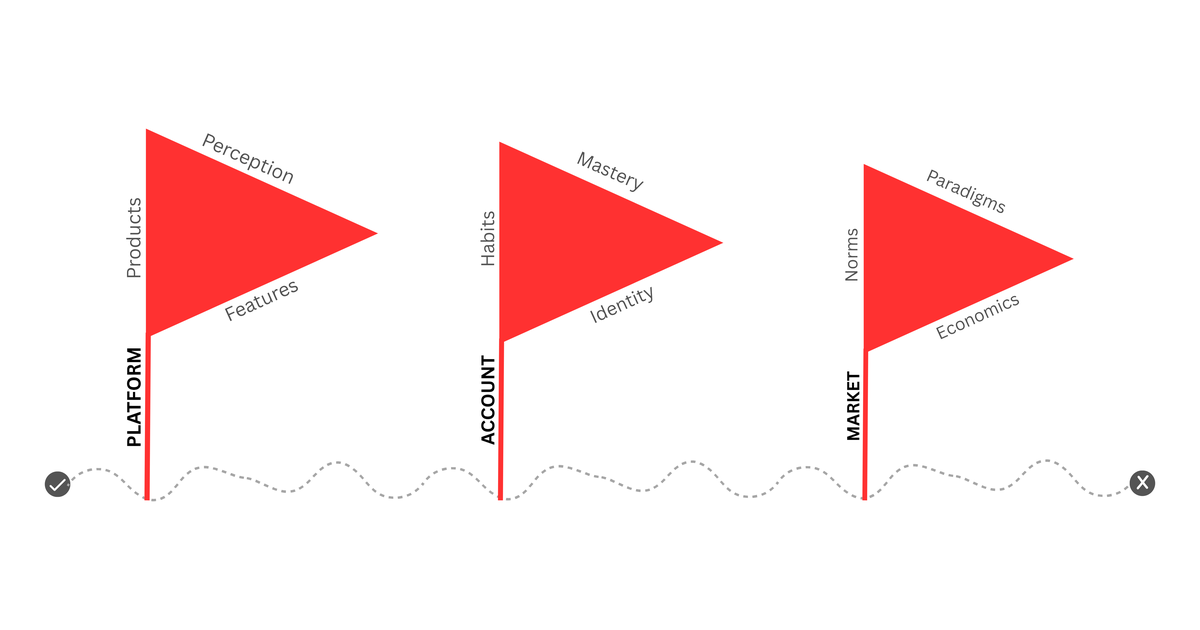
- Platform – the changes you make
- Account – the changes in your user’s life
- Market – the changes in the world
Each one is a customer signaling that they need help. Ignore the flag and they’ll often leave for a competitor who fills the gap. Lower it and they go deeper: more seats, more usage, an upgrade, because you showed them exactly what they needed.
Churn and expansion aren’t two different problems. They’re the same moment. It just depends how you handle it.
Most of the stories below come from my podcast, Churn Flags, where I hand a growth leader one piece of customer feedback about their product, we trace it back to one of the nine Change Flags, and then we build an experiment to take it down.
Platform: the changes you make
1. Features
If a brand is paying you to make a promotional video, you check your background for dirty dishes – and, more importantly, for other companies’ logos. If another brand’s logo shows up and that company sees it, they can legally ask for the video to come down, and the brand that paid for it can’t use it.
Cohley, an influencer management platform, has an AI tool that scans videos for logos before creators submit them, plus a whole suite of AI tools for writing briefs with custom requirements. Michelle Green, their head of growth, came on the show, and Cohley had spotted something in their data: companies that had been with them for a decade were submitting the exact same briefs they’d submitted ten years earlier. The AI features were in onboarding, so every new customer knew about them. The old customers had no idea they existed. (Read the Cohley episode writeup.)
That’s a Features flag. We launch something, send an email, maybe run a launch event, and the team moves on to the next thing on the roadmap. Existing customers might miss the email. Even if they see it, they never get real onboarding into the feature – nobody helps them build it into how they work, the way we do at signup.
2. Products
I was connecting one of my Paperform forms to Kit when a banner popped up introducing Paperform’s newest product, Stepper, a really sweet integration tool. I was thrilled and signed up on the spot. A couple of weeks later, Paperform’s co-founder was on my podcast and mentioned, as an aside, that Stepper had launched almost half a year earlier.
I was a power user, and I missed the launch for nearly six months. That’s a Products flag: the same gap as Features, except the thing the customer doesn’t know about is a whole product you shipped or acquired and want to cross-sell. (That story is Episode 1.)
3. Perception
If I asked you to send me a Bitly, you’d send me a shortened link. In our heads, Bitly is a link shortener. It’s grown into much more than that. On Churn Flags, I read Bitly’s CMO, Tara Robertson, a review from a customer asking Bitly to build something like Linktree. Bitly has a Linktree alternative. They shipped it years ago, and it lives in the sidebar navigation, in plain sight. (Listen to the Bitly episode.)
That’s a Perception flag. Like the other Platform flags, it’s you changing without the customer realizing – but here it’s a whole repositioning, and the customer’s blinders hide it. They’re happily using you for what they signed up for. Nothing fires on the dashboard. They could be using you for so much more.
And if you’re feeling a little smug about your Platform flags: as an industry, Platform is the side we handle best. Account is the side we handle worst.
Account: the changes in your user’s life
4. Identity
I signed up for Suno, the AI music generator, to make music for my podcast, and paid for Pro because I needed the commercial license. Once my tracks were downloaded, I dropped to the free plan. I didn’t need the paid features anymore. Or did I?
Because I use Suno every day at 4:45, right before my kids clean up. Nobody wants to clean up, so every day I have Suno write them a custom cleanup song about something that happened that day, or something coming up tomorrow, or whatever mood they’re in. I’ve stopped touching the professional tools: the editor, the complementary tracks. If Suno were paying attention, they’d see me shifting from music producer to music hobbyist. Instead of pop-ups for producer features like the studio, they’d show me the paid features a hobbyist wants, like unlimited downloads.
That’s an Identity flag. Behavior shows you the role shifting. Someone gets promoted, executes less and reviews more, and suddenly starts clicking export, audit, permissions. Those proxy behaviors tell you something important is changing.
Sometimes the identity shift is a literal new person: the champion leaves and someone else gets shoved into their seat, holding a tool they have no idea what to do with. Accounts churn at a dismal rate after a champion leaves – I quoted 51% within twelve months. Jane Portman of Userlist and I went deep on it on the show. (Listen to the Userlist episode.)
5. Habits
When my business was a sole proprietorship, I ran my Stripe exports once a year, for my accountant. Once I became an LLC, she needed my payments every two months. So every two months I go into Stripe and download my reports myself. It’s sensitive data I won’t hand to an admin or to AI, and it’s a real time suck.
Stripe can see me hit export every two months. They could upsell me on Sigma, which runs those reports automatically on a schedule. I wouldn’t have wanted Sigma as a sole proprietor exporting once a year. Now I would.
That’s a Habits flag. When users change habits, they’re open to the features that support the new ones. Those changes are usually sitting in your usage data waiting for someone to notice – but the daily-active-users line is green, so nobody digs into what that daily usage actually is.
6. Mastery
The review I brought to Storylane’s head of demand gen was interesting for two reasons. The customer complained, then said they’d left for a competitor. And Storylane’s support team had replied to the review: the feature you’re looking for exists, and here’s the documentation. (Read the Storylane episode writeup.)
That’s a Mastery flag. Onboarding is deliberately narrow, because we want users to reach value and build the usage muscle – and it’s a great thing that we’ve standardized that. But plenty of capabilities aren’t a fit at signup. As customers get better at the product, or at the outcomes it gives them, they start looking for advanced capabilities. If we don’t notice they’re ready, the features built for that skill level just sit there, because we only ever showed them the beginner version. The proficiency signal is in your data. Most teams just aren’t tracking at that level of detail.
Market: the changes in the world
Probably the trickiest side, because you have zero control over it.
7. Economics
Last year was rough for course creators. Everyone was saying courses are dead, and a lot of creators I know were rethinking their strategy. I host my courses on ThriveCart, and the whole time, ThriveCart has been emailing me with positioning that makes them both cost-effective and better at selling courses than their competitors – not just at hosting them. They pitched features that help me sell, like the Facebook Pixel so I can run ads to my courses, and their affiliate program as another revenue stream. Instead of bracing to lose customers who’d stopped making sales, they pushed the features that help those customers in that economic reality.
That’s an Economics flag. Some features matter more when people feel the pinch; others read as bloat and get you cut, so you have to be precise about what you promote in a squeeze. It works in reverse too: when cash is flowing, customers need to hear about your expansion features, or you start to feel too lean. Your value prop has to be re-argued to your customers for the new context, not just to your prospects.
8. Norms
I love Kit (formerly ConvertKit). I’m an affiliate, and I wrote an entire blog post about what I love about it. I still almost switched to Substack a few months ago, because newsletters are going social and everyone was raving about Substack’s discoverability and growth. What kept me on Kit was a podcast episode, in which Anne-Laure Le Cunff credited her recent newsletter growth to one specific Kit feature: the Creator Network.
That’s a Norms flag: an industry-specific shift that changes behavior. Podcasting going video-first. Ecommerce going headless. Newsletters going social. The market demands a capability, we build it, and then – say it with me – we fail to tell our users. So they go looking for a competitor who tells them they meet the new norm.
9. Paradigms
In 2023, I was in a casual brainstorming session on Zoom when a tooltip popped up: Try our new whiteboard feature. Zoom had shipped it back in 2020, when COVID made the virtual meeting category fiercely competitive and remote collaboration critical. They built it to meet a change the market served up, then didn’t tell me about it for three years. If I’d gone looking for that capability in 2020, I would have switched, even though they had it.
That’s a Paradigms flag. Paradigms are bigger than norms: they change what your user considers table stakes, and they usually cut across every industry. Zoom’s was COVID. Ours, right now, is obviously AI. You’re probably heads-down shipping AI features as fast as you can. Forgetting to tell customers you have them, after all that work, and when they’re actively looking for them, is a real loss.
Not one of the nine is a product gap
Go back through the stories. Cohley had the AI briefs. Paperform had Stepper. Bitly had the link-in-bio tool. Suno had the hobbyist features, Stripe had Sigma, Storylane had the feature its churned customer wanted. ThriveCart, Kit and Zoom had all built for the shift before the customer went looking.
In every case, nothing had to be built to keep the customer or grow the account. The company only had to show them, when the flag went up, that it already had what they were looking for. Take off their blinders.
Find and take down those flags, and you’re always the helpful salesperson, never the annoying one.
Want to know which flags are up in your product? I built the Change Flags™ Quiz to diagnose them. Your results come with a scorecard benchmarked against a composite of your competitors, what each flag is costing you, and a 90-day recovery plan.
Watch or listen to the whole talk below.

Listen & subscribe: Apple Podcasts · Spotify · YouTube · everywhere else
Which of the nine Change Flags are flying in your product?
Take the Change Flags™ Quiz. About four minutes, scored head to head against a composite of your competitors, with a dollar figure per flag and a 90-day recovery plan.
Start with Episode 1
Read the full episode transcript
Nikki Elbaz (00:00) About half a year ago, I walked into a gift shop. I was looking for a gift for my niece for her bat mitzvah. And of course, I could have just gone online and bought something online, but I specifically went in store because I wanted the kind of service that you can only get from a local boutique. I didn’t know what’s popular among my niece’s classmates. I didn’t know what people get for bat mitzvahs, and I really wanted some guidance picking a present that she would enjoy the most.
Nikki Elbaz (00:27) So I walk into the store and the sales lady is busy with another customer. She’s showing her around. They are taking their time. She’s wrapping her gift, twirling the ribbons, and I’m kind of aimless, kind of, you know, wandering the aisles, picking up this necklace, looking at this journal. I have this real task in front of me, but I don’t want to go it alone. I want help. And there’s no one here to help me. She finally comes over.
Nikki Elbaz (00:52) And she gives me the full pitch on all the different popular gifts. She shows me these adorable custom jewelry boxes. I walk out with something that my niece is really happy with, or at least that she pretends she likes. So I am so grateful that there was this knowledgeable sales lady to help me out. A few months later, I walk into the same store because I had another gift to buy. And this time I knew exactly what I wanted. I wanted a gratitude journal.
Nikki Elbaz (01:17) I knew exactly where they were in the store. I knew exactly what color I wanted, and I was ready. This time, the sales lady was not busy with someone else, and she came straight over. “You’re back! Did your niece love the jewelry box? Wait, wait, wait, you have to see these!” And she walks me over to this wall of Squishmallows and she says, “These are what 12-year-olds are obsessed with right now. This axolotl is flying off the shelves! This one glows in the dark! This strawberry cow is scented!” and she hands it to me to smell.
Nikki Elbaz (01:45) Listen, the cow did smell good, which is not something you could say for every cow. But even more impressive, she remembered me and my niece, six months later. But I was not interested in Squishmallows. I was not shopping for a 12-year-old this time. I was shopping for a friend. Even worse, I only gave myself 10 minutes for this errand, and this lady and her Squishmallows were in my way.
Nikki Elbaz (02:09) I forgot my slides. So is this lady helpful or is she annoying? And of course, it depends. It depends if I need help. It depends if I need what she is showing me. It depends on the context. She is not inherently annoying and she is not inherently helpful. It depends entirely on what I need right in that moment and what she is offering me right in that moment. Cut, new scene. Now we have a story about you.
Nikki Elbaz (02:33) Okay, picture this scene. You are at an all-hands meeting. You ask your team, what is the last initiative that we ran to grow revenue from existing customers? What do they answer you? Maybe you shipped an MCP and now your customers are using your product more than ever. Maybe your AEs ran a land-and-expand sprint and your seats are growing by the day. Maybe you acquired a new product and you are integrating it into your product suite.
Nikki Elbaz (02:59) But I am guessing that whatever initiative you are thinking of, it is some version of new. A new feature, a new segment, a new tier. Because as an industry, this is how we define expansion. If we want to sell them something more, we need to build them something new. Especially right now. AI is shipping everything so much faster. Every one of us is shipping more than we have ever shipped in our entire careers.
Nikki Elbaz (03:24) If new was the answer to the question, then NRR would be ticking up. But it isn’t. Because the best way to get existing customers to spend more is not to build them something new. It’s to show them what we have already built. And more specifically, to show them at the moment that they are open to hearing about it. Honestly, we have always been really good at shipping. Our products are good. Our products are not the problem.
Nikki Elbaz (03:50) The problem is that our existing customers have blinders. They are in your product every single day. They see it through the lens of habit. They think they know it cold. They built their habits around the features that they onboarded on. And they have subconsciously concluded that the product that you were when they signed up is the product that you are today. And honestly, we have these same blinders. We, as an industry, place more emphasis on demand gen and acquisition
Nikki Elbaz (04:18) than we do on retention, even though we have heard this HBR stat about it costing five times more to acquire a new customer than to retain an old one. We’ve heard it a million and a half times, and yet we still place more emphasis on acquisition. I think that we have this subtle mindset that once a customer adopts, they’re our customer. We have them and we don’t need to keep marketing to them. Yes, of course, we have to tell them about the new stuff, and obviously we want to keep them happy.
Nikki Elbaz (04:46) But they’re already sold. They’re already in the product. They already know what they have access to because they have access to it. These two things combined mean that the outside market has a better picture of what your company does than what your own customers do. Your prospects have seen this year’s website. Meanwhile, your customers are working off the mental version of the one that they saw when they signed up.
Nikki Elbaz (05:11) We almost have to shout louder at our customers than we do at our leads, because a lead is open. They have no preconceptions, they have no habits, there is nothing to undo or rebuild in their minds. A customer already holds a picture of you, and you need to actively change their mind. So if we want our customers to understand the capabilities that will lead them to expansion, then we need to communicate more. We need to send more emails, ship more tooltips,
Nikki Elbaz (05:39) trigger more pop-ups. And I know what you are thinking. You are thinking, are you kidding me, Nikki? More communication, more pop-ups, more modals, more emails? We are trying to cut back. We want to say less, not more. We don’t want to be annoying. Pop-ups get in our users’ way. Pop-ups are annoying. We use them really sparingly. We are not giving more. So let’s go back to our sales lady. When was she in the way?
Nikki Elbaz (06:07) When I already knew what I wanted. True. Our users have built habits. Often they do know what they are looking for. They have a goal in mind when they log in and they don’t want a pop-up in their way. But sometimes things change and they do need help. When I walked into that store and I wanted help, the sales lady was the opposite of annoying. She was helpful. I was looking for her and I was waiting for her. Are pop-ups inherently annoying? Are pop-ups inherently helpful?
Nikki Elbaz (06:35) You know where I’m going here. It depends entirely on the context. It depends on whether our users need help right then, in that moment. The problem was never about how much we communicate, rather, whether it’s relevant, what we have to say, if it’s relevant when they see it. And you know, we actually understand this intuitively. If you look at the customer lifecycle, we front-load communication.
Nikki Elbaz (07:00) When they initially join our company, when they onboard, we talk to them a ton. We are okay sending them emails. We are okay sending them nudges because we know that they need the education and we give them everything that they need. We give them all that guidance. We help them see all the value of our product because we know that they need it. And the same thing on the other side. When the retention dashboards fire and we see a customer at risk, we know again that we need to sell the value.
Nikki Elbaz (07:27) So we’re okay sending win-backs and we’re okay starting to pop up nudges again. We understand this. But there’s all this space in the middle between when a customer adopts and when a customer is about to leave, where we don’t feel allowed to send them anything except for some new stuff. Blasts, launches, new, new, new. Meanwhile, there are moments in their lifecycle when they need help and they are floundering and we just don’t realize that.
Nikki Elbaz (07:52) So that is why we are here today, to find the moments when a user is genuinely looking for help, where we can help them use our product better, more, and hopefully expand usage of our product and also save them from churning. These are the moments when you can step in and guide them, not by getting in their way, but by paying attention and being relevant. I call these moments Change Flags.
Nikki Elbaz (08:15) There are nine moments in the customer lifecycle where something shifts and reevaluation begins, way before anything fires in the at-risk dashboards. There are three main flags, and there are three sides to each flag. The first flag is Platform, the changes that you make. The second is Account, the changes that your user makes. And the third side is Market, the changes that happen in the world. Again, each of these changes is a customer signaling to you that they need help.
Nikki Elbaz (08:44) If you ignore the flag, they will often leave for a competitor who will fill in the gap for them. But if you lower the flag, they will go deeper. They add more seats, more usage, they’ll upgrade because you’re showing them exactly what they need. Because churn and expansion are not two different problems. They are the same moment. It just depends how you handle it. So we’re gonna walk through every flag with a story. Most of the stories come from my podcast, Churn Flags.
Nikki Elbaz (09:09) In every episode, I hand a growth leader one piece of customer feedback on their product. We trace it back to one of the nine Change Flags, and then we build an experiment to take it down. So let’s start with the first, the Features flag on the Platform flag. If you were an influencer and there was a product paying you to make a promotional video, you would have to take a really good look at your background to make sure that,
Nikki Elbaz (09:30) yes, there are no dirty dishes in your sink and you have exactly the right amount of chic items on your countertop, but more importantly, you would have to check your background, your clothing, and anything else that shows up on camera for logos. Because if you would record your video with another logo and that company that owns the logo sees the video, they can ask the company who paid you to make the video to take it down. They have all the legal rights to do that. The company that paid you for this video can no longer use it.
Nikki Elbaz (09:59) Cohley is an influencer management platform, and I had the head of growth on my podcast. And they have a nifty AI tool that searches videos for logos before influencers submit their videos. And they actually have a whole suite of AI tools, and brands can submit briefs and look for influencers to create videos for their products. And they can streamline this process and get really custom requirements with these AI tools. And Cohley saw in their data that tenured companies who have been with Cohley
Nikki Elbaz (10:26) for a decade are submitting the same exact briefs that they were submitting 10 years ago. They don’t know that they have access to these new custom briefs. Cohley has obviously put their AI features into their onboarding, so every new customer knows about it. But what about the old customers? They have no idea that this feature exists. That is a Features flag. When existing customers are not aware or using our new features, when we launch something new,
Nikki Elbaz (10:52) we send out an email, we run a launch event, we send out a touch point, and then the team moves on to the next thing on the roadmap. Meanwhile, our existing customers might have missed the email. They might have seen the email, but even if they’ve seen it, they haven’t really gotten any real onboarding to help them build this new feature into how they actually work. We haven’t helped them make it a habit the same way that we do when they first sign up. That’s a Features flag. Next flag.
Nikki Elbaz (11:21) I was hooking up one of my forms in Paperform, which is a form builder, to my email platform, Kit, formerly ConvertKit, and I saw a little banner pop up at the top introducing Paperform’s latest product, Stepper, which is a really sweet integration tool. I saw the banner, I was really excited, I signed up immediately. It was perfection. Then a couple weeks later, I had the Paperform co-founder on my podcast, and she mentioned as an aside that they had launched Stepper almost a half a year prior.
Nikki Elbaz (11:50) I missed this product launch for nearly half a year. That’s a Products flag. And it’s basically the same thing as a Features flag, where a customer does not know of a capability that you have launched, but in this case, it’s a product that you’ve either shipped or acquired and you’re trying to cross-sell users on, versus a feature. Next flag. If I asked you to send me a Bitly, what would you send me? A shortened link, right? Bitly, in our minds,
Nikki Elbaz (12:12) is a link shortener. And yet, over the years, it has expanded to something so much more. In fact, on Churn Flags, I read Bitly’s CMO a review from a customer asking Bitly to build something like Linktree. Bitly has a Linktree alternative. They shipped it years ago. And you know where it lives? In the sidebar navigation, right in plain sight. That is a Perception flag. Again,
Nikki Elbaz (12:38) because it’s on the Platform flag, this is you changing your product without the customer realizing. But in this case, it’s an entire repositioning, but they have their blinders on. They don’t notice. They are still happily using you for whatever it is that they signed up for. Nothing’s firing on the dashboard, everything is fine. They are happy they’re using your product. But meanwhile, they could be using you for so much more. Now we move on to the next flag. And if you’re feeling a little smug that you don’t have that many Platform flags,
Nikki Elbaz (13:05) the Platform flag is the flag that as an industry we handle the best. The Account flag is the one that we handle the worst. So brace yourself. All right, starting with the first flag on the Account flag. If you haven’t heard of Suno, the AI music generator, I am really sorry, but I am giving you a new rabbit hole to explore. It’s exceptionally fun. I first signed up to Suno to make music for my podcast. I paid for Pro
Nikki Elbaz (13:33) because I needed the commercial license to download the tracks and use them for my podcast. Once I downloaded my tracks though, I switched down to the free plan because I no longer needed the paid features, right? Or do I? Because I use Suno every day at 4:45, right before my kids clean up. You know how it is. Nobody wants to clean up. So I started using Suno to make it a little more fun. Every day I pick something that happened that day or something that’s gonna happen the next day, or I just like play around with whatever mood they’re in.
Nikki Elbaz (14:02) And I have Suno generate them a custom cleanup song. It’s really fun. Anyway, I am no longer using any of the professional production tools that I was using when I was making the podcast music. I’m no longer using the editor. I’m no longer creating complementary tracks, so I have a different range of musical tracks to use across my podcast. If Suno paid attention to these shifts, they would see how I am shifting from becoming a musical producer to a musical hobbyist.
Nikki Elbaz (14:28) And so instead of giving me pop-ups that are related to these more producer-relevant paid features like the studio, they would be showing me the paid features that are more relevant to a hobbyist, like unlimited downloads. That’s an Identity flag. When a user’s identity changes, the behavior shows us that the role is shifting. For example, if they’re given a promotion, they execute less and they review more. They suddenly start clicking export, audit, permissions.
Nikki Elbaz (14:56) These are proxy behaviors that show us that there’s an important shift happening. And by the way, sometimes an identity shift actually is a real identity shift, a new person, not just someone occupying a new role, like when a champion leaves and someone else is shoved into their seat. They’re handed this new tool that they have no idea what to do with. The last episode of Churn Flags is exactly on this, and I highly recommend that you subscribe and watch it.
Nikki Elbaz (15:21) Because the stats on this kind of churn flag are particularly dismal. 51% of accounts churn after 12 months after a champion leaves a company. All right, next flag. Back when I structured my business as a sole proprietorship, I ran my Stripe exports once a year when my accountant needed them.
Nikki Elbaz (15:41) Once I switched to an LLC, my accountant needed my payments every two months. And so every two months, I go into Stripe and I download my reports. This is a task that I don’t want to hand to anyone else. It’s sensitive data. I don’t want to hand it to an admin. I don’t want to hand it to AI. I have to do it myself. And it’s a real time suck. Meanwhile, Stripe has this data that I go in every two months and hit export.
Nikki Elbaz (16:03) And they can upsell me on Sigma, which runs this automatically on schedule for me. That’s a Habits flag. Because users change habits. And when they change habits, they are open to different features that can help them with these new habits. I would not have signed up for Sigma when I was a sole proprietorship. I don’t need it if I’m only exporting once a year, but now I do. Usually these habit changes are just sitting there in your usage data, waiting for somebody to notice.
Nikki Elbaz (16:30) But we are placated by the green daily active users, and we don’t dig deeper into what that actual daily usage is. Next flag. When I had the head of demand gen for Storylane on the podcast, the review I gave him was especially interesting for two reasons. The first is that the customer gave their complaint, and then they said that they left for a competitor. Ouch. The second is that the support team had responded to this review saying,
Nikki Elbaz (16:55) “The feature that you’re looking for exists. Here’s the documentation for it.” In this case, it was a Mastery flag. When we onboard a customer, we are so focused and our communications are very narrow because we want to get that user to value. We want them to hit that moment so they build the usage muscle and integrate the product into their life. This is a good thing. It is a great thing that we have standardized this kind of onboarding. The problem is that there are so many other capabilities that may not be a fit when they first sign up.
Nikki Elbaz (17:24) But as they get better at using our product or the outcomes that our product gives them, they’ll start looking for more advanced capabilities. And if we don’t realize they’re ready and we don’t show them these capabilities, then the features built for that level of skill just sit there, because we only ever show them the beginner version when they first signed up. Again, hitting that proficiency level is sitting in your data. We’re just not tracking this level of detail. Next flag, Market.
Nikki Elbaz (17:53) Probably the trickiest one because we have zero control over it. First flag. Last year was a very difficult year for course creators. Everyone was saying courses are dead. A lot of course creators I knew were revamping their strategy and trying to figure things out. I host my courses on ThriveCart, and the whole time ThriveCart has been sending me emails that position them as both cost effective and better at selling the courses than their competitors. Not just great at hosting content,
Nikki Elbaz (18:20) but at selling the content that I am hosting. They’ve been pitching me on the features that help me sell my courses, like the Facebook Pixel so that I can run ads to my courses. They pitch me on becoming an affiliate so that I can bring in more revenue. They have their finger on the pulse of what their customers are experiencing. And instead of just worrying that they’re going to lose a whole bunch of customers because they’re no longer making sales, they are pushing the features that help their customers in that kind of economic reality.
Nikki Elbaz (18:48) This is an Economics flag. Some features are just more important to promote when people are feeling the pinch. Other features actually read as bloat and will get you cut, and you have to be a little precise about what you promote during an economic squeeze. And by the way, the Economics flag works on the flip side. When the economy is booming and cash is flowing, your customers need to hear about your expansion features. If you hold back, then you feel too lean.
Nikki Elbaz (19:14) Your value prop needs to be re-argued to your customers, not just to your prospects. We’re good at doing this to our prospects, but to our customers? Whatever new context the economic reality is giving them, that’s what we need to show them. Next flag. I use ConvertKit, which is now Kit, and I absolutely love them. I am actually an affiliate, and I wrote an entire blog series about what I love about them. Despite this, I almost switched to Substack a few months ago.
Nikki Elbaz (19:41) Because newsletters are changing. They are becoming social. Everyone has been raving about the discoverability and growth potential that Substack gives newsletter operators, so I very seriously considered making the switch. Oddly enough, it was a podcast episode that kept me on Kit. I heard Anne-Laure Le Cunff on a different podcast, and she attributed her recent newsletter growth to a specific Kit feature, the Creator Network. That’s a Norms flag.
Nikki Elbaz (20:08) Norms are industry-specific changes that shift behavior. Podcasting going video-first: every podcaster now is doing video. Ecommerce going headless: your site where you host your ecommerce store needs to be headless. Or newsletters going social. Every industry has their own shifts that create expectations. The market demands a certain capability. We build to meet that demand. And say it with me, you know where I’m going here.
Nikki Elbaz (20:34) We fail to tell our users about it. So they go looking for a competitor who does tell them that they are meeting that norm. Next flag is very similar to Norms. In 2023, I was in a meeting in Zoom. It was a casual brainstorming session, and a tooltip popped up: “Try our new whiteboard feature.” Zoom had shipped this feature back in 2020 when COVID, come on, the virtual meeting category got
Nikki Elbaz (21:00) really competitive and helping people collaborate remotely was critical. They shipped this feature to meet a change that the market served up, but they didn’t tell me about it for another three years. If I was looking for that capability back in 2020, I would have switched over, even though they had it. That’s a Paradigms flag. Paradigms are bigger than norms. They change what your user even considers table stakes, and they usually apply across the board rather than just
Nikki Elbaz (21:26) being industry specific. Zoom was a COVID story. Right now, our paradigm is obviously AI. You are probably heads-down working to ship your AI features as fast as you possibly can. I know the pressure to ship AI is intense. Forgetting, though, to communicate that we have these capabilities once we ship them is such a loss, especially because we’ve worked so hard and especially because our customers are really looking for them.
Nikki Elbaz (21:54) So that’s all nine flags, and you will notice that not one of them is a product gap. In each of these cases, you do not have to change anything to keep up or keep your users. You just have to show them that you already have what they’re looking for when the flag goes up. You just have to take off their blinders. I actually built you a quiz to help you diagnose your Change Flags, and your results come with a scorecard, a benchmark against a composite of your competitors,
Nikki Elbaz (22:20) what the flags are costing you, and even a 90-day recovery plan. Because if you find and take down these flags, you will always be the helpful salesperson and not the annoying one.