I have a giant spreadsheet of headline formulas that I collected over the years, from various blog posts, courses, and books.
You know what’s better than { outcome }? Nothing.
{ offer } in a word: { outcome }.
This isn’t { expectation }. It’s { transformation }.
Well, actually, AI killed that last one. But the rest survived.
I pull up this spreadsheet every time I draft an email or a landing page, and I go down it row by row, trying each one on my offer. The formulas are solid, and I’ll usually land on something good in a few minutes.
But interestingly, half the time, the winning lines don’t actually fit into the formulas.
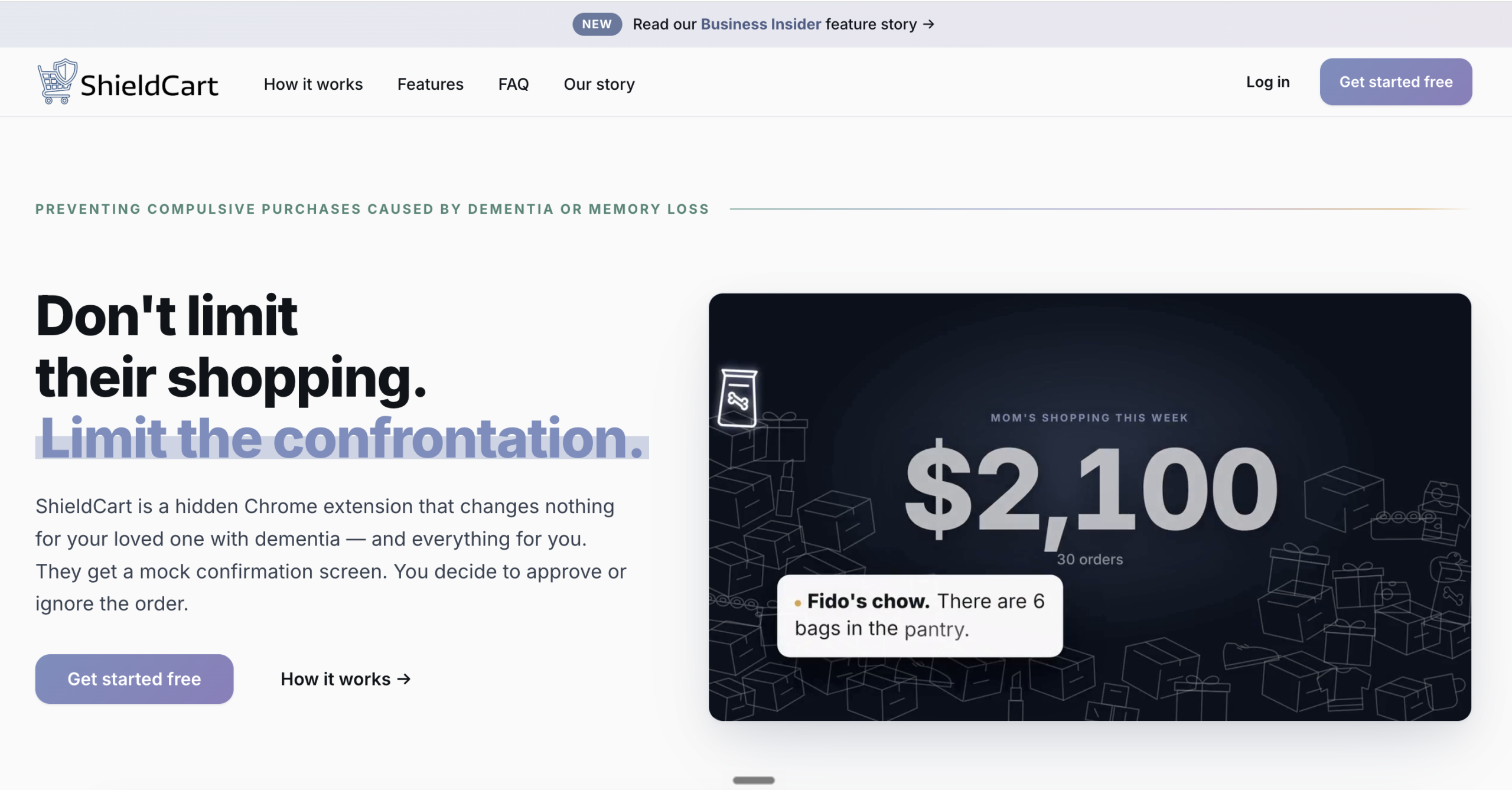
Let’s take the homepage for my side hustle, ShieldCart, the app that protects people with dementia from compulsive purchases.
The headline on the features section, “Heavy on options. Light on hassle,” came straight from a formula: Heavy on { desired result }. Light on { typical cost of result }.
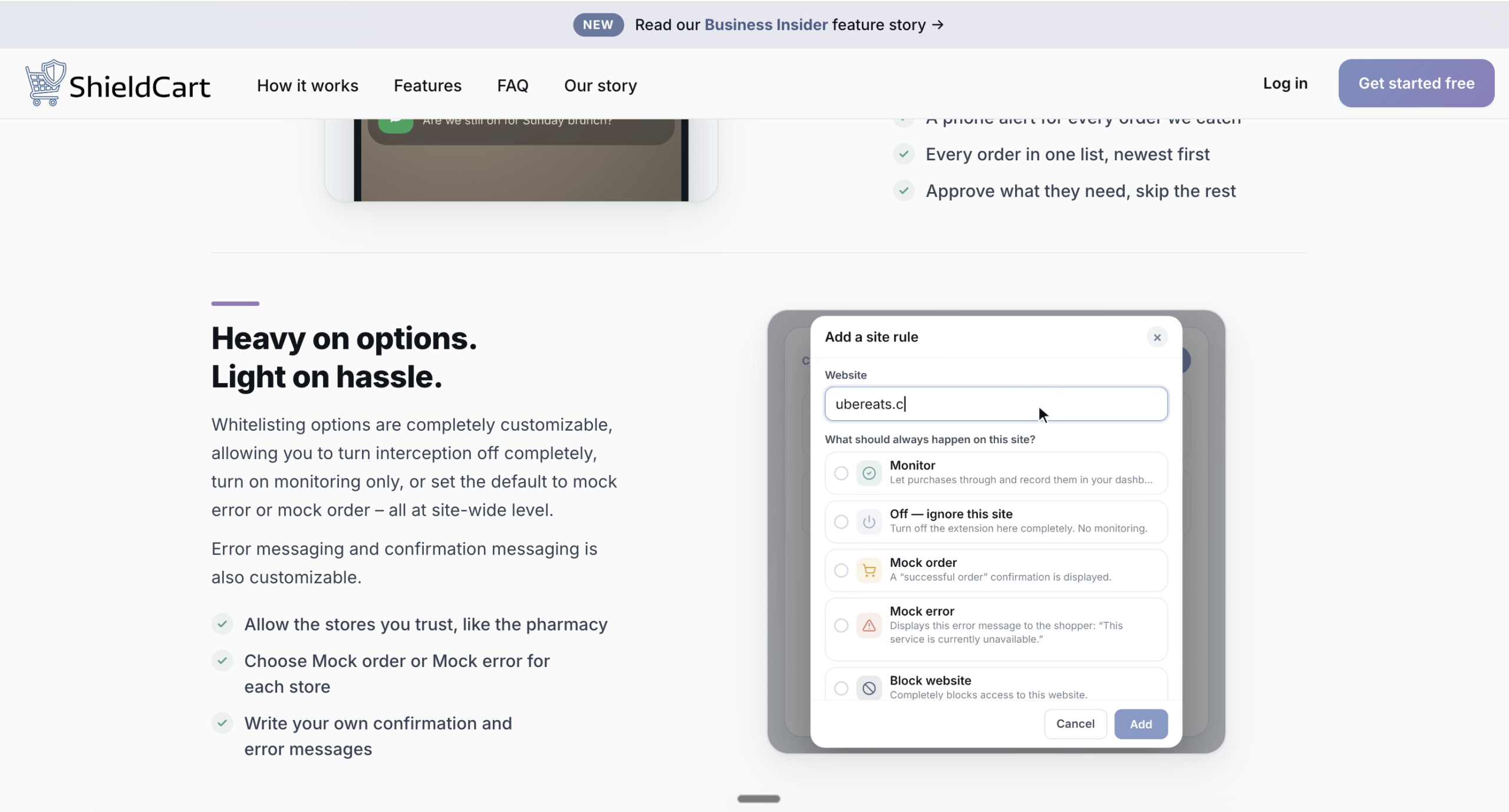
Meanwhile, the headline of the hero, “Don’t limit their shopping. Limit the confrontation.” wasn’t swiped straight from the spreadsheet, it was a grandchild of “You don’t have to { unwanted step } to { desired outcome }.”
Your best idea is at the bottom of the list
There’s research behind this. Across a series of studies, Brian Lucas and Loran Nordgren at Northwestern had people brainstorm in rounds, then had outside judges rate the ideas. The ideas that came later, after the obvious ones were used up, were rated as more original. And here’s my favorite part: people consistently underestimated how much they had left in them.
Our best ideas usually come after we’ve discarded our first ones. Even if we think we’re done.
I see this in my spreadsheet. And I saw this when I was Head of Email for Copyhackers and was instructed to draft 25 subject lines for every email I wrote. All with a new angle, mind you.
When a subject line becomes a cartoon
And sometimes, a good idea already implemented brings about an even better idea, down the line.
Userlist’s onboarding is about ten emails, following a cartoon named Susie as she works through setup. Susie does this, Susie does that. It’s charming – and also very effective, because every vignette doubles as an instruction for the reader.
But it didn’t come first.
An earlier Userlist lead nurture had borrowed the Friends episode format, so every email opened with “The one with…” It was fun to write, readers liked it, and when it came time for onboarding, Userlist co-founder Jane Portman went back to that well: what other formulas do TV series and movies use to describe what happens in an episode?
The onboarding checklist masquerading as a TV formula
Surprisingly, Jane found that most of the TV formulas weren’t suited for email nurtures. But one fit like a glove: “hero does something” sounded a lot like “a set of action steps that the hero can take.” The TV angle stopped being a cute wrapper and started doing the work that onboarding exists for.
I’d have said that the Friends lead nurture takes the cake for creative nurture. It’s the type that PMMs discuss and swipe, the type that goes viral. But Jane took it a step further, and now the Userlist onboarding is even more delightful than the nurture that inspired it.
So I’ll keep opening my spreadsheet. Because getting to the bottom of it is how I find the headline that was never on it.
In the episode
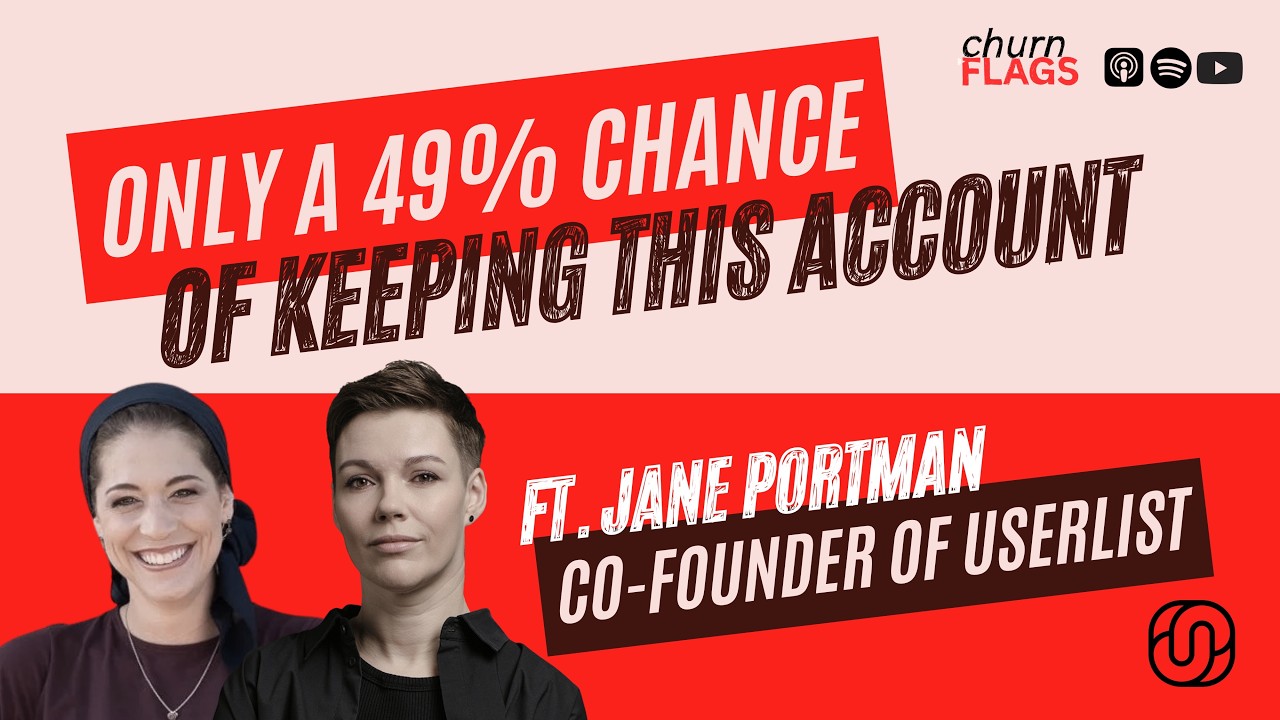
What else did we dive into in Episode 6 of Churn Flags?
The 51% churn risk that’s triggered when a champion leaves and someone new inherits the account.
Three teammates sending from one support address on purpose.
And the big, happy, paying account that turns out to have “almost like an activation problem.”

Listen & subscribe: Apple Podcasts · Spotify · YouTube · everywhere else
Which of the nine Change Flags are flying in your product?
Take the Change Flags™ Quiz. About four minutes, scored head to head against a composite of your competitors, with a dollar figure per flag and a 90-day recovery plan.
Read the full episode transcript
Nikki Elbaz (00:00) One of the most dangerous things that can happen to one of your accounts is a champion leaving. Studies cite a fifty one percent chance of churn within twelve months of a champion’s departure, sixty five percent if it’s an executive who leaves. So of course we have a playbook for this. There’s even an entire category of tools that helps us track champion movement. When your champion turns up somewhere new, you find out, you get an alert, and you follow that champion to their new company. Somebody is reaching out that same week, because a person who loved your product at their last job is the best pipeline that you can expect to get, right? But there is still that account that they just left. Someone new just landed in that role, in the seat that your champion vacated. What happens to them? We also have a play for this. We find out who took over. We send them a personal note. We take a meeting, read the account history, the background before showing up to that meeting. The meeting is nice and pleasant, we’re building a new relationship. It is a decent play. Companies that act on an executive change within forty eight hours see a thirty three percent more likelihood of renewal. Thing is, only half of CS teams do this. And more pointedly, and what we’ll dig into in this episode, is that we view this play as a relationship builder. We’re trying to woo them. We’re buttering up, we’re getting on their good side. If we truly thought about them and what they need, stepping into a new role, we would be doing something drastically different. Something that we will be digging into with our guest today. Here’s how this show works. Every episode I hand my guest one real piece of customer feedback. A three-star review, a Reddit rant, a puzzling survey response. In this episode, our guest is bringing us a story. Together, we trace this feedback back to what it’s actually telling us. Not the surface ask, the shift underneath it. Because the SaaS playbook has trained us to read feedback one way, as a feature request, a line for the product backlog, something to ship or politely decline. What that misses is that feedback is usually waving a flag that something has changed for your user. And they’ve started reevaluating how you fit into their life. I call these moments change flags and there are nine of them that matter. Three happen when you change your product, three when shifts happen in your user’s life, and three in the market at large. Catch one late and the user just slips away. No complaint, no warning, gone. Catch it in real time and the same moment flips. They go deeper, they upgrade, they add seats or usage that they didn’t know they needed. Same flag, two outcomes. And obviously we’re angling for the second. We end off each episode with a theoretical experiment that we build live to address the change flag. Or like in today’s episode, our guest will show us what they’ve actually built to fix the flag and how it’s working for them. I’m Nikki Elbaz, bringing 15 years of SaaS marketing to these experiments. Welcome to Churn Flags. One thing before we start. Customer feedback is the most reactive way to spot a change flag. In the work I actually do, we catch these from a whole slew of proactive indicators. Feedback is the last piece and the smallest. It’s just the one we can talk about most easily publicly. If you are suspecting that you are not tracking some of these indicators, you’re probably right. Not enough SaaS companies are. So you’ll want to take the Change Flags quiz. It takes less than five minutes, runs you head to head against a composite of your competitors and even line items what each flag costs you. Find the quiz at nikkielbaz.com/quiz. Our guest today is Jane Portman of Userlist, an email automation platform built specifically for SaaS companies. Jane is one of the most creative people working in SaaS. You see her creativity across all her work. In her product, in her own communications, and in where she spends her time. She is a kindred fighter of best practices, and she consistently comes up with ideas that seem so obvious in hindsight, cost almost nothing, are not hard to execute, and yet no one else is doing them. They’re not hard, they’re not expensive, they’re just outside the playbook. And maybe that’s why Jane was able to spot the change flag that she did. Let’s hear how she noticed it.
Jane Portman (03:37) We try to combine low touch and high touch ways of approaching customer success. Our new users receive hands-on onboarding. And then that slowly fades into something that we’re trying to do lower touch, which is inviting every paying account to do a quarterly review call. We send out a very short broadcast that has a calendar link for 20 minutes with us to talk about what’s on their mind. And surprisingly, people do take us up on that. And the first time we did this in the beginning of the year, we discovered a very interesting pattern. We had a handful of people book a call with us because they inherited a functioning Userlist account and they didn’t know what to do with it. They were not sure what the strategy was. They didn’t know much about the tool and they did not receive the training that we usually do for new accounts.
Nikki Elbaz (04:27) This is the identity flag. One of three on the account side. And it pops up when who your user is changes. Identity flags are one of the trickiest flags to notice. Because we don’t track the right behavioral data to see how our users change. We don’t know when they get promoted and suddenly need admin capabilities. We don’t know when the remit expands and they suddenly need your tool to cover three more tasks. It’s the same human in the seat. But practically speaking, capability speaking, they are a completely different user. This particular spin of the identity flag, when a champion leaves and it actually is a different user in the seat, is a little easier to spot, mostly because there are tools that track this, though not everyone uses them. So it is still a tricky flag, it’s just a little less tricky. Still tricky because we don’t actually treat them as a new user. The account is fine, it’s 18 months old. Things are triggering, behavioral data looks healthy. Meanwhile, the most important seat in the account is on day one. Remember that play, the one that upped renewal by thirty three percent? Find the successor, send the note, read the history, take the meeting. Look at what every one of those steps is for. They’re all built for managing the relationship. Which makes sense. The relationship is what got you the account, right? But the person who just inherited a new tool, they specifically don’t have a relationship problem. They have a competence problem. Somebody handed them a fully integrated, complex system and left them to it. They’re not feeling the pain of relationship. They’re feeling the pain of having no idea what is going on. So let’s look at what Jane built to tackle this identity flag, starting with how she gets notified that this flag pops up to begin with. What indication do you have that people are taking over a new seat? Is it just that they’ve added a new seat to their account? What is that indicator that tells you, okay, this needs to trigger this automation?
Jane Portman (06:08) We have a specific trigger type in Userlist, which is ‘user joins company’. So this is the main trigger,
Nikki Elbaz (06:13) Hmm.
Jane Portman (06:14) and we have an additional filter on this that the company that they join needs to be at least two months since their account creation date. So that means that the official onboarding period is well over and they may be joining down the road without the context.
Nikki Elbaz (06:28) It helps to have a really awesome tool like Userlist to help you with these kinds of things.
Jane Portman (06:31) Well, we use Userlist for Userlist. That works.
Nikki Elbaz (06:36) Yeah, go ahead.
Jane Portman (06:36) We also drop them into the educational onboarding sequence, the same onboarding that new accounts receive. We have an additional trigger. So Userlist workflows can have multiple triggers. So different situations can trigger the same workflow. And that’s one of those occasions when somebody joins, they will receive the typical onboarding training. And then that little customer success nudge.
Nikki Elbaz (06:58) I love hearing that because so often it’s just, okay, this account got their onboarding. Now they’re in this middle stage of active, engaged customer. They are working. They are an account that is okay and fine and we don’t have to touch them anymore. And you’re saying, no, something just happened here and this person needs a new onboarding. They need to receive what they never saw. So what kind of triggers do they get? Does it come for them as, if they don’t join that customer success call, then they get the onboarding, or they get the onboarding hand in hand with that one?
Jane Portman (07:26) No, they get both. They get both.
Nikki Elbaz (07:28) Two different playbooks fired off the same trigger. Playbook one is Jane personally offering you a call. That is a fantastic offer. A legitimate subject expert, the co-founder no less, walking you through the system you just inherited. If you can run that, that is a golden play. If you have 4,000 accounts and 11 CSMs, that’s what Playbook Two is for. The educational onboarding sequence. Send the same one that every new customer gets to this brand new customer. It is the simplest play. It’s a sequence you have already written, just sent to someone who is technically not day one, but for all intents and purposes, is. It’s so obvious when we say it, but we just don’t do it. They have inherited a working system. Nothing is broken. We just don’t notice. Meanwhile, they are totally lost and they need our guidance. Again, so obvious, but somehow not in our standard playbook. Do you have any plans for the people who have access to this new tool that they have no idea how to use it? Aside from obviously that onboarding workflow that you already gave them, are there any other plans to help them?
Jane Portman (08:27) Do you think we should send them shirts?
Nikki Elbaz (08:28) That’s
Jane Portman (08:30) One of the fun aspects, you can automate a swag delivery with email because
Nikki Elbaz (08:33) Thanks.
Jane Portman (08:34) you can, it’s actually not hard, but I’m surprised that not too many companies take advantage of that.
Nikki Elbaz (08:40) This is exactly what I mean. You have this creativity and this depth into your customers that lets you come up with these ideas that you say they’re not hard and they’re not, but they’re outside the playbook. People just don’t do them. But you’re right. It’s so easy.
Jane Portman (08:57) Those customer loyalty emails that are intended for customers who are already paying a few months and years in. There’s so much you can do with them. You can ask for reviews, you can share your referral programs, you can offer them swag, you can invite them for different types of calls. Email is just a channel for different kinds of engaging opportunities. Space out that campaign, one, two months apart, and your loyal customers receive different nudges to do stuff. But of course, not every company is offering that and doing such kind of automations. But it’s a little low-hanging fruit, essentially.
Nikki Elbaz (09:33) I want to talk for a second about your educational guides because I know that they are so good. Tell me about how you came up with the idea for your onboarding and was it like your first idea and it just came out and it was perfect as it was? I mean, obviously you had to iterate and all that, but talk me through that because it’s just so good.
Jane Portman (09:51) I think you’re referring to the recent onboarding campaign for customers that we launched that includes the adventures of Susie in the mainland. So that’s a different story from the actual guides. The actual guides, we have a handful of fundamental blog posts, which are our frameworks. And they’re very long, very detailed, basically step-by-step guides for making things happen. Of course, we don’t use the same copy in the emails and what we came up with is a more fun way to feed the onboarding steps to users. The idea came from message titles, actually, subject lines, because one
Nikki Elbaz (10:30) You
Jane Portman (10:30) of our old sequences for a lead nurture was using the subject line format from the Friends movie series, “the one with the segments,” “the one with the something.” So we had a lead nurture of like 15 emails, and they all started with “the one with the…” And it was so much fun, at least for us to write. And I’ve heard that people have good comments on it as well. So I sat down with ChatGPT, I think at that time, that would be Claude these days. I sat down with AI to do research on what other movie series and movies, what formulas they’re using to describe what’s happening in each episode, so that we can make it more of a storytelling.
Nikki Elbaz (11:09) Wow.
Jane Portman (11:10) And I discovered that most of them were not applicable, most formulas and patterns, but some of them like “this hero does something,” like “Susie does something and et cetera, et cetera.” And we were like, that’s interesting because that sounds like a step of action, a set of action steps that the hero can take. And somehow Susie came up as a name. We brainstormed it and settled on it. And we made a little illustration for her. And just used it as the guiding idea to describe what Susie is doing on every step of their journey. And we have an imaginary account that Susie is setting up and doing segmentation and finding clarity with segments and so on and so forth.
Nikki Elbaz (11:53) I dropped some of the adorable onboarding emails in the show notes. So take a look if you want to read them in more detail. Highly recommend. You’ll notice that I just used the word adorable to describe onboarding emails. Which tells you that there is something unique about them, right? And we are all angling for unique. We know our users are flooded with messaging. And so we need to stand out. And if we’re honest, it’s fun to be a fun brand. But fun and funny and unique marketing cannot be our end goal. It’s not the point. Yes, we have to capture attention. But then what? What are we capturing attention for? The Userlist onboarding is attention grabbing. But then it directs your attention to using the product well. It is strategy at its finest. This is how Jane uses creativity as a mechanism to see opportunity. She saw a pattern in her quarterly reviews and built a trigger for it. She turned personas into cartoon characters. Swag is a real strategic marketing method. And by the way, she has a great episode on using swag to grow your SaaS that I’ll link in the show notes. So yes, go enjoy the cartoon illustrations and the fun tone under the onboarding. But make sure you notice what the email is actually doing for the readers, aside from giving them some entertainment.
Jane Portman (12:59) Another implementation detail I can share is we have subscription topics. Essentially, they’re there to help users manage subscription preferences. And we make special effort to make those customer success emails really stand out. They have a dedicated topic, so people have an opportunity to opt out of user onboarding, but keep those occasional customer success emails, such as quarterly review invitations, as well as that kind of check-in that I mentioned. And we also are doing deliberate styling difference between those. Our lead nurture and user onboarding are more fun, more educational. They have illustrations in them and those emails that are customer success, they need to be operational looking. I mean, it’s a very short, very personal message saying like, Hi, I am Jane. This is my personal calendar link. And also those emails have another sender profile with my full name and the replies go straight into my inbox, not the support inbox.
Nikki Elbaz (13:57) It makes all the difference for them to know that they are reaching out to you versus to support, that they’re actually going to talk to you. That is a subtle difference that really makes a big difference.
Jane Portman (14:07) We make a big deal about the role of sender profiles in Userlist. Again, you can have multiple sender profiles. They may even have the same address attached to them. For example, most of our communications go out from support@userlist. But some of the news are coming out from Jane. Some are coming out from Benedikt. Our marketing manager, Krista, is sending out updates that say, hey, this is my newsletter, written by Krista. So, we do present our team members as personas speaking to users, even though technically speaking, they all come from the same support email address.
Nikki Elbaz (14:41) So often it’s very much like team@whatever and then it’s such a corporate non-team sort of email because they know that the best practice is to send it from a name or from team or that kind of thing but it doesn’t actually look like it came from a person. It doesn’t have to look like it came from a person, but it should feel like it came from a person. So I love that you separate the style of the email from the sender of the email. That just makes so much more sense. When I was looking for a review that we could feature, I came across a Reddit thread where somebody was like, Userlist versus this competitor, that competitor, this competitor. How in the world do you choose one? They all do the exact same thing. Obviously, that’s not true. I’m sure you could get on a soapbox and talk about all the different things that you do differently. But one thing that I’m picking up again and again is that, besides all the features, even how you run the UIs, and what you prioritize, the fact that you’re so hands on as a founder, how you think about, and how you present to your customers, impacts so much. Because number one, you’re showing up for strategy calls, that’s giving them super high value. You’re thinking about what they need and how to present it to them in a way that’s just so much more high touch and customized to them and engaging and interesting. Can we not downplay that? That’s interesting and important.
Jane Portman (15:53) Thank you.
Nikki Elbaz (15:54) But it’s really amazing to see how it’s not just about the features, it’s also the way you think about it affects the features, affects the experience. And that’s what I would answer them. I should go back to the Reddit thread and be like, you won’t get anything better than this because this is customized to exactly what you need. So I just wanted to throw that out there.
Jane Portman (16:11) Thank you so much. Glad that resonates with you, but it’s not just me. It’s also a dedicated support engineer answering tickets, doing so many daily
Nikki Elbaz (16:20) Yeah.
Jane Portman (16:20) technical troubleshooting, investigation that is way beyond typical support that you can find at the Mailchimps of the world. I deliberately say Mailchimp because it’s obviously not a competitor. It’s a general platform. And we also host a different type of call, which is a technical call. We have a variety of different calls that we offer to people during their onboarding. And one of them, if they need it, is also an ability to get on a call with our engineering team to discuss integration details. And that is a short one. And the other one that you mentioned, that deserves a bit more detail, is a roadmapping session that I do as a strategist, where we sit down for 60 minutes, pretty big call, with every new customer. And we develop their data tracking plan. We talk about their segmentation and what exact steps they need to implement in order to set up correctly and make sure their implementation is good. Because behavior-based email automation is rooted in good data. And if they fail at planning that data, then everything else goes out of the window.
Nikki Elbaz (17:23) Like any good strategy, Jane starts with roadmapping. And guess what? When you start an engagement with me, that’s how we start too. Our sprints start with an audit, where we map the whole life cycle and find change flags. Only then do we build experiments that take down the flags that are costing you the most. My sprints are a good fit if you are a post-growth SaaS who can’t keep throwing best practices at your churn. In fact, your churn is not just a retention problem anymore. It’s becoming an expansion problem. Again, churn and expansion are two sides of the same coin. And if you want to solve both, head to nikkielbaz.com/sprints and book a diagnostic.
Jane Portman (17:56) They’re called quarterly reviews, but it’s usually not used for reviews just based on our experience. If someone wants to, let’s say, troubleshoot a specific workflow in their account, then they can do this anytime by emailing support. So they use the review time to get a little bit of training here and there, to make sure they’re on the same page with the strategy, a lot of other miscellaneous questions that you would never think about until they bring it to your plate. And also, yeah, it brings good context about the health and the situation of different accounts because it varies obviously and not everybody has a thriving account with 20 workflows in it. Sometimes it makes you realize, there is a really big account that has almost like an activation problem. They have like one or two workflows. They’re probably happy, but also that means we could do better in terms of engagement and helping them adopt the tool a bit deeper.
Nikki Elbaz (18:48) Thank you, Jane. You just gave me the entire Churn Flags thesis in a sentence. Big account, revenue flowing in. Behavioral data looks perfect. But there is so much more to work with if we just look a little more deeply. Yes, the accounts are active, but one-to-two workflows? That’s nothing. That’s not an activated account. Expansion is opportunity deep. When a champion leaves, the account looks fine. They stay healthy, but they’re at a 51% churn risk. Your health scores are watching accounts. Accounts don’t churn. People do. And the identity flag shows us to pay attention to the people behind the accounts. If you think there are flags flying in your company that nobody’s catching, head to the Change Flags quiz, nikkielbaz.com/quiz. And four minutes later, you’ve got a scorecard and a ninety day recovery plan.